Scalenut vs Autoblogging.ai for Keyword Research
You need keyword research that turns into published posts, not just a spreadsheet. Scalenut and Autoblogging.ai both promise that pipeline, but they solve different parts of it, and picking wrong costs you either monthly fees or hours of manual work.
This comparison breaks down how each tool handles SERP competitor analysis, LSI extraction, and bulk generation into WordPress. You will see the pricing differences and get a clear verdict on which platform fits your workflow.
Quick Verdict: Scalenut vs Autoblogging.ai for Keyword Research
If you need a dedicated keyword research suite with deep competitor analysis and content optimization, Scalenut is the stronger choice; but if you want to turn keywords into fully published articles at scale with minimal effort, Autoblogging.ai wins.
Both tools touch keyword research, but they approach it from different directions. Scalenut is generally built around planning and optimization workflows. Autoblogging.ai focuses on execution, moving from a keyword or topic to a finished, publishable article.
That distinction matters most when you compare what happens after the research phase ends. One tool helps you decide what to write. The other helps you actually ship it.
| Factor | Scalenut | Autoblogging.ai |
|---|---|---|
| Primary strength | Keyword research and content optimization workflows | Turning keywords into published articles at scale |
| Keyword and SERP support | Research-focused features for planning content | SERP competitor analysis and semantic SEO tools |
| Publishing path | Optimization-oriented, article creation is one part of the workflow | One-click WordPress publish |
| Content output | Draft and optimization assistance | 1M+ articles generated, 10+ AI modes, 35+ languages |
| Quality safeguards | Optimization scoring and related guidance | Human proofreader included in all plans, 21-point SEO audit, featured snippet optimization |
| Track record | Established SEO and content platform | Trusted by 40,000+ content creators, 4.9 average rating |
| Support and updates | Varies by plan tier | 24/7 support, new features shipped weekly |
| Credits | Plan-dependent usage limits | Credits rollover |
| Integrations | Connects with common marketing tools | 35+ integrations |
The pattern is clear. Scalenut gives you a research and optimization environment. Autoblogging.ai gives you a production pipeline that starts with keyword and SERP insight and ends with a published post.
For teams that already have a research stack, adding Autoblogging.ai fills the gap between a keyword list and live content. Credits rollover means unused capacity is not wasted, and 35+ integrations help fit the tool into an existing setup.
The human proofreader included in all plans is a notable differentiator, since it adds a review layer before publishing. Combined with the 21-point SEO audit, it addresses the two biggest concerns teams raise about AI writing: accuracy and on-page quality.
Scalenut remains a reasonable pick if research depth is your only priority. Autoblogging.ai is the better fit when the goal is producing and publishing content consistently, backed by 24/7 support and new features shipped weekly.
Recommendation: Choose Scalenut if you need a standalone keyword research and optimization workspace. Choose Autoblogging.ai if you want keyword-driven content researched, written, checked, and published without the manual handoffs.
At a glance: how Autoblogging.ai compares to Scalenut, Autoblogging.ai for Keyword Research on the features that matter most.
| Feature | Autoblogging.ai | Scalenut | Autoblogging.ai for Keyword Research |
|---|---|---|---|
| Keyword Research | ✓ | ✓ | ✓ |
What Is Autoblogging.ai?
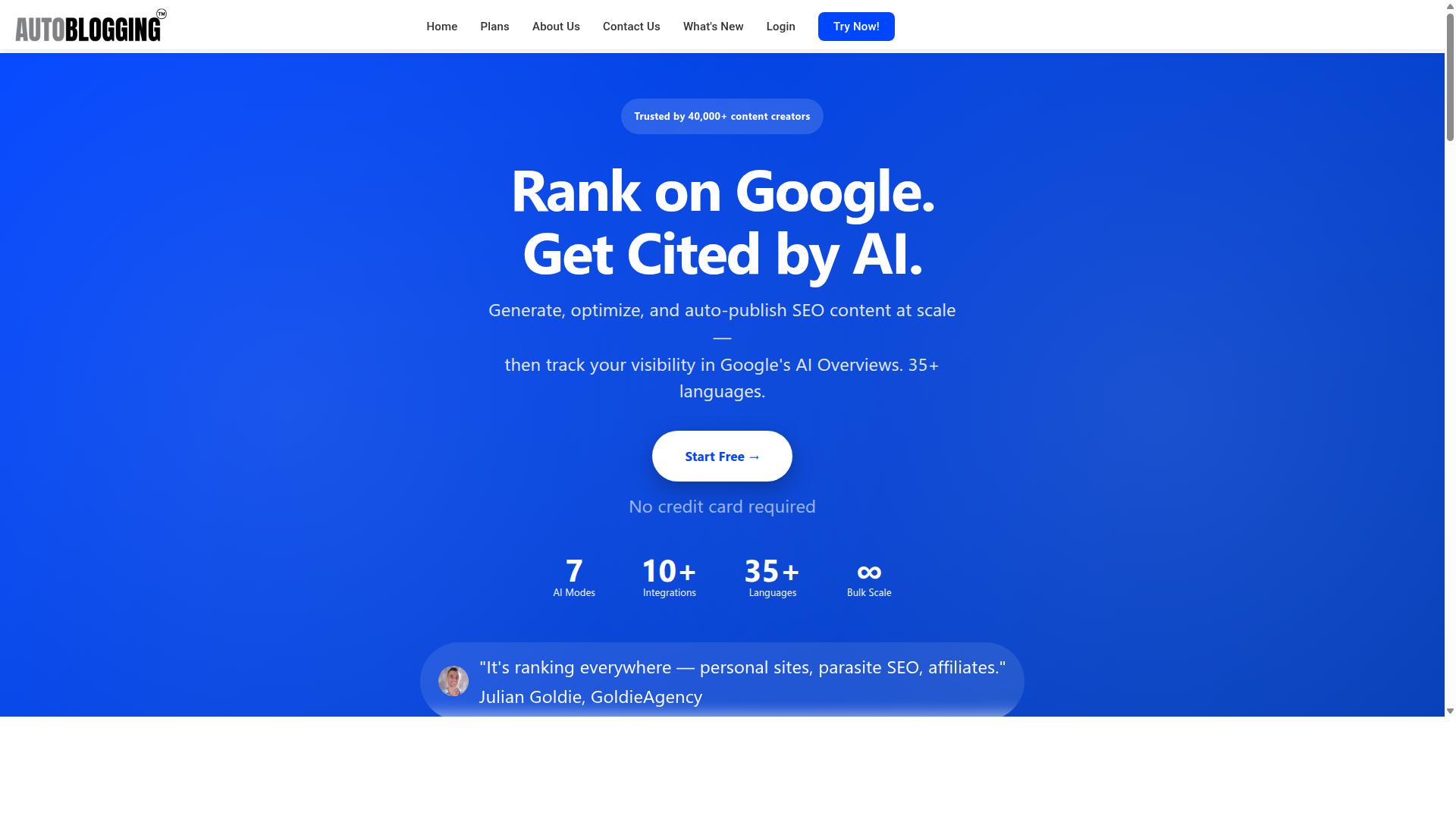
Autoblogging.ai is an AI-powered article generation platform that automates the entire content creation process, from keyword to published post. It is built for people who need content at scale without assembling a large writing team.
The product comes from Digimetriq.com and was founded in 2022 by Vaibhav Sharda. Its stated mission is to help bloggers, website owners, and agencies save time and improve their online presence through cutting-edge technology.
That mission has a clear commercial angle. Autoblogging.ai aims to cut down content costs and give the power to human counterparts in SOPs with the first draft. Digimetriq, the company behind it, aims to replace human counterparts entirely.
In practice, the platform generates articles using distinct modes, including Quick Mode and Godlike Mode. It also supports bulk generation of up to 500 articles, which matters for anyone running multiple sites or managing client work.
The tool is used globally by bloggers, website owners, and agencies. For a keyword research comparison, that positioning is worth noting: Autoblogging.ai is designed to take a keyword and carry it through to a finished post, rather than stopping at the research stage.
- Who it serves: bloggers, website owners, and agencies
- Core promise: save time and improve online presence through cutting-edge technology
- Generation modes: Quick Mode and Godlike Mode
- Scale: bulk generation up to 500 articles
- Origin: a product of Digimetriq.com, founded in 2022 by Vaibhav Sharda
For readers weighing Scalenut against Autoblogging.ai, the distinction is one of emphasis. Scalenut is generally described as an SEO and content optimization suite with keyword research and content briefs at its core. Autoblogging.ai centers on automated article generation and publishing at volume.
Both approaches can support a content marketing workflow. The question is whether you want a research-first toolkit or a pipeline that turns keywords into published drafts with minimal manual effort.
What Is Scalenut?

Scalenut is an AI-powered content marketing platform that combines keyword research, content optimization, and AI writing to help teams create SEO-friendly content. It sits in the same broad category as many modern SEO tools, aiming to reduce the number of separate applications a content team needs.
The platform is generally positioned for content marketers, SEO professionals, and agencies. Rather than serving only one part of the workflow, it tries to cover the journey from finding keywords to publishing finished drafts.
According to publicly available information, its main pillars tend to fall into three areas. Each one targets a different stage of producing content that ranks.
- Keyword research: discovering topic ideas, search volume signals, and keyword difficulty estimates
- Content optimization: guidance on structure, terms, and on-page elements as you draft
- AI writing: assisted drafting and editing to speed up production
In practice, that means a writer might research a topic, build a brief, draft an article, and refine it for search intent without leaving the tool. The appeal is convenience and a shorter handoff between research and writing.
It is worth noting that specific capabilities, limits, and pricing can change over time. Anyone comparing options should check the vendor's current documentation rather than relying on secondhand summaries.
For the purposes of this comparison, the key point is that Scalenut is a multi-purpose content platform. Its keyword research is one component of a larger suite, which shapes both its strengths and its trade-offs when weighed against more focused tools.
What Is Autoblogging.ai for Keyword Research?

Autoblogging.ai approaches keyword research from a content-generation perspective, using SERP competitor analysis and LSI keyword extraction to inform article creation. Instead of stopping at a list of keywords, the platform carries those insights forward into finished, publishable content.
The centerpiece of this approach is Godlike Mode, which performs SERP competitor analysis, extracts LSI keywords, and builds knowledge graphs to inform article creation.
LSI keyword extraction matters because modern search engines evaluate topical depth, not keyword repetition. By pulling related terms and entities from ranking pages, Autoblogging.ai helps content cover the surrounding vocabulary that semantic SEO rewards.
The knowledge graph layer takes this further. It maps how concepts in a topic connect to one another, which supports long-tail keywords and the fan-out queries that sit underneath a head term. The platform even includes a Fan Out Queries tool for this kind of expansion.
What separates Autoblogging.ai from a standalone keyword tool is the handoff. Keyword insights flow straight into article generation and then into publishing, with WordPress integration, Web 2.0 platforms, and multi-platform support for Shopify, Wix, Webflow, Blogger, and Ghost.
For readers who want an all-in-one solution, that pipeline is the appeal. You can move from a seed keyword to a published post without stitching together separate tools for research, writing, and distribution. Bulk Generation extends the same logic to up to 500 articles via CSV, and supporting tools like Semantic SEO Analysis, Topical Maps, and the Snippet Optimizer round out the workflow.
Features Compared
When comparing features, Autoblogging.ai excels in automated content generation and publishing, while Scalenut offers robust keyword research and content optimization tools. The breakdown below looks at three areas that matter most for keyword-driven content workflows.
First, keyword research depth, including SERP competitor analysis and LSI extraction. Next, the path from keywords to published content, covering one-click WordPress publishing and bulk generation. Finally, language coverage, integrations, and support, which determine how well each platform scales across markets and teams.
Keyword Research Depth: SERP Competitor Analysis and LSI Extraction
Autoblogging.ai's Godlike Mode performs SERP competitor analysis and extracts LSI keywords to help you understand what top-ranking content looks like.
The mode also extracts knowledge graphs, which help connect related entities and concepts around your topic. That structure supports semantic SEO, giving search engines clearer signals about what your article actually covers.
Keyword difficulty and search volume are surfaced indirectly through this analysis. You get a practical read on how competitive a term is based on who currently ranks, rather than a standalone metric in isolation.
Scalenut takes a different route. It offers dedicated keyword research tools, including keyword difficulty scores and search volume data, which suits users who want a traditional research dashboard before writing begins.
The real distinction is what happens after research. Autoblogging.ai is built to move from SERP insights straight into content generation, so the gap between competitor analysis and a finished draft stays small.
From Keywords to Published Content: One-Click WordPress and Bulk Generation
Autoblogging.ai shines in its ability to turn keywords into published content with one-click WordPress integration and bulk generation of up to 500 articles. The WordPress connection supports unlimited sites through a plugin, with scheduled auto-posting.
Beyond WordPress, content can also be pushed to Web 2.0 platforms such as Medium, Dev.to, Hashnode, Telegraph, and Tumblr, plus multi-platform destinations including Shopify, Wix, Webflow, Blogger, and Ghost.
The platform offers 10+ AI modes, each suited to a different job:
- Quick Mode for fast, free article generation, including single and wizard options
- Godlike Mode for SERP-driven, research-backed articles
- Bulk Generation for producing up to 500 articles from a CSV file
- News Mode with Google News integration
- Amazon Reviews Mode for product-focused content
Scalenut, by contrast, centers on content optimization and brief creation. Those are genuinely useful for planning, but the platform may not match the same level of automated publishing that Autoblogging.ai provides.
For teams whose bottleneck is production volume, that difference matters. Research is only valuable once it becomes published content, and Autoblogging.ai is designed around that final step.
Language Coverage, Integrations, and Support
Autoblogging.ai supports 35+ languages, offers 35+ integrations, and provides 24/7 support, making it a versatile tool for global content creation. New features also ship weekly, so the platform keeps expanding rather than standing still.
On the integration side, the named options include WordPress, Shopify, Wix, Webflow, Blogger, Ghost, Medium, Dev.to, Hashnode, Telegraph, and Tumblr, along with API access, Zapier, and n8n. That range lets you slot the tool into an existing publishing stack.
Support extends beyond the help desk. Every plan includes a human proofreader, and the platform also offers an AI Proofreader for automated review before publishing.
Scalenut supports multiple languages and integrates with popular tools as well. Those specifics vary by plan and release, so it is worth checking current documentation rather than assuming parity.
Weighed together, Autoblogging.ai offers the more extensive support and integration footprint for this use case. A 24/7 support window plus weekly updates gives teams a stronger safety net when content operations run around the clock.
The takeaway is straightforward. If your priority is research depth alone, Scalenut holds its own. If you want research, generation, and publishing in one loop, Autoblogging.ai covers more of the workflow.
Pricing Compared
Autoblogging.ai offers transparent monthly and annual plans based on credits, starting at $19 for 40 credits and scaling up to $999 for 5,000 credits. Every tier is published openly, so you know exactly what you pay before you commit. There are no hidden seat fees or surprise add-ons layered on top of the base price.
The full monthly lineup is straightforward and easy to map to your content volume:
- Starter $19 for 40 credits
- Regular $49 for 120 credits
- Standard $99 for 300 credits
- Gold $179 for 600 credits
- Premium $249 for 1,000 credits
- Enterprise $999 for 5,000 credits
Annual billing brings the effective monthly cost down across every tier. Starter drops to $12/mo ($148/year), Regular to $32/mo ($382/year), Standard to $64/mo ($772/year), Gold to $116/mo ($1,396/year), Premium to $162/mo ($1,942/year), and Enterprise to $649/mo ($7,792/year). For anyone running steady keyword research and blog automation, the yearly option cuts the per-credit cost noticeably.
Two details matter for budgeting. First, all plans include credits rollover, so unused credits are not lost at the end of a billing cycle. Second, new accounts receive 10 free credits per month with no credit card required, which lets you test the workflow before paying anything. Additional credits can be purchased when you need a short-term boost, and payments are accepted via Visa, MasterCard, American Express, and PayPal, with bank transfers available for annual enterprise plans through Stripe. You can cancel anytime.
Scalenut, by contrast, generally uses a subscription tier model rather than a credit system. Its plans tend to be structured around feature access and usage limits, and pricing may vary by seat or by how much of the platform you use. Scalenut may also offer a free trial, though the specifics are best confirmed on its own site since published terms change.
| Factor | Autoblogging.ai | Scalenut |
|---|---|---|
| Pricing model | Credits tied to article generation | Subscription tiers, generally feature or seat based |
| Entry price | $19/month (40 credits) | Varies; confirm on provider site |
| Annual discount | Yes, lower effective monthly rate | Commonly offered, terms vary |
| Credits rollover | Yes, on all plans | Not a credit-based system |
| Free access | 10 free credits monthly, no card needed | May offer a free trial |
The core value difference comes down to what you are paying for. Autoblogging.ai prices around credits for article generation, so your spend maps directly to output volume. Scalenut's model may charge per seat or by feature usage, which can be less predictable when your team grows or your research needs shift month to month.
For keyword research specifically, that predictability matters. If your goal is turning keyword lists into published content at scale, a credit model keeps costs tied to results rather than to how many people log in. Autoblogging.ai also offers Done For You packages for teams that want hands-off execution: Starter at $1,200 for 1,000 articles, Pro at $1,600 for 1,000 articles, Corp at $4,000 for 1,000 articles, and Senpai at $10,000 for 1,000 articles. That range gives both solo bloggers and larger operations a clear path without custom quotes.
Who Should Choose Autoblogging.ai
Autoblogging.ai is ideal for bloggers, affiliate marketers, and agencies who need to produce large volumes of SEO-optimized content quickly and cost-effectively. Its core strength is not research depth but output: turning keyword ideas into published articles at a scale that manual writing cannot match.
The platform was built for bloggers, website owners, SEO professionals, marketing agencies, content creators, and affiliate marketers. That mix matters, because each group has a different bottleneck. A solo blogger needs consistency. An agency needs volume across many clients. An affiliate marketer needs pages live before a trend cools.
Where keyword research tools often stop at a list of ideas, Autoblogging.ai is designed to move those ideas into finished content. For teams already confident in their keyword targets, that shift from planning to publishing is the real value.
Autoblogging.ai serves a wide range of site types:
- Personal sites and blogs
- Parasite SEO pages
- Affiliate sites
- Client websites
- Portfolio sites
- Local sites
That breadth says something about how the tool is used. It is not tied to one niche or one business model. A local service site and a large affiliate operation can both run on the same system, just with different keyword sets and publishing schedules.
The clearest use cases center on bulk generation, WordPress integration, and automation. Bulk generation handles the volume problem. WordPress integration removes the manual step of copying drafts into a CMS. Automation keeps a site publishing on a schedule instead of in unpredictable bursts.
For agencies, this changes the economics of client work. Producing content for multiple sites by hand requires either a large writing team or a slow delivery timeline. An automated pipeline lets a small team cover more client websites, portfolio sites, and local sites without multiplying headcount.
Affiliate marketers benefit for a related reason. Testing a new keyword angle usually means publishing several articles and waiting to see what ranks. The faster those pages go live, the faster the feedback arrives, and the faster budget shifts toward what works.
Time savings are the through-line. Keyword research still matters, and tools like Scalenut remain useful for planning. But once the plan exists, Autoblogging.ai is the stronger choice for anyone whose constraint is production capacity rather than research depth.
Scalability works the same way. Adding a tenth site or a fifth client does not require a proportional jump in hours. The system absorbs the extra volume, which is exactly what bloggers, agencies, and affiliate marketers need as their portfolios grow.
Who Should Choose Scalenut
Scalenut is best suited for content marketers and SEO professionals who prioritize in-depth keyword research and content optimization over automated publishing. For these users, the research phase is not a stepping stone to publishing. It is the work itself.
Scalenut is generally positioned as a research and optimization workspace. Its typical audience includes content teams, SEO agencies, and freelance writers who want hands-on control over every stage of the writing process. Instead of handing the work to automation, they prefer to guide it.
These users usually want to make their own decisions about keyword targets, SERP analysis, and search intent. They review keyword difficulty and search volume data, compare competing pages, and shape content briefs themselves. Tools in this category tend to support that judgment rather than replace it.
Consider a practical example. A freelance writer receives a brief for a long-tail keyword with moderate difficulty. They open a tool like Scalenut, study the top-ranking pages, check which subtopics appear again and again, and then build an outline by hand. The final draft reflects their editorial choices at every step.
That level of involvement appeals to professionals who treat content optimization as a craft. It also makes sense for teams producing a small number of high-stakes pages, where the cost of a weak draft outweighs the time saved by automation.
Scalenut also tends to fit workflows built around semantic SEO and topic clusters. Writers who want to map internal links, refine header tags, and tune on-page elements manually often prefer a tool that keeps them in the driver's seat.
If your process depends on manual review at every stage, or if your clients expect visible editorial input, Scalenut is likely the better match. It rewards users who bring their own strategy to the table.
On the other hand, teams that publish at volume may find that manual research and drafting becomes a bottleneck. That is where an automated approach such as Autoblogging.ai fits more naturally, since it is built around blog automation and article generation rather than step-by-step manual control.
- Content teams that want to direct strategy rather than delegate it
- SEO agencies managing research-heavy client campaigns
- Freelance writers who build briefs and outlines by hand
- Specialists focused on semantic SEO and topic clusters
The short version: choose Scalenut if control matters more to you than speed. Choose an automated publishing tool if consistent output at scale matters more than handling every step yourself.
Who Should Choose Autoblogging.ai for Keyword Research
If your keyword research needs are tightly coupled with content generation and publishing, Autoblogging.ai is the better fit. Its keyword work does not sit in a separate dashboard waiting for you to export a list and hand it to a writer. Instead, keyword discovery, SERP analysis, and article creation live inside one workflow that ends with a published post.
That distinction matters most for blog automation at scale. Teams that publish frequently do not want a research tool on one tab and an article generator on another. Autoblogging.ai closes that gap by treating keywords as the starting point of production, not the final deliverable.
Scalenut, by contrast, is generally positioned as a broader content marketing suite where keyword research stands on its own. That suits researchers who want a dedicated workspace for metrics and planning. It suits less well anyone whose real bottleneck is turning those keywords into finished, published articles.
Here is how the two approaches differ in practice:
| Consideration | Autoblogging.ai | Scalenut |
|---|---|---|
| Core strength | Keyword to published article in one platform | Standalone keyword research and content optimization |
| SERP analysis | Built into Godlike Mode alongside LSI keywords and knowledge graph extraction | Generally offered as part of its research toolkit |
| Scale | Bulk Generation of up to 500 articles via CSV | Typically aimed at individual briefs and campaigns |
| Publishing | WordPress integration with unlimited sites, one-click posting, plugin, and scheduled auto-posting | Typically relies on export or manual publishing steps |
| Best for | Automation and speed at volume | Granular keyword metrics and manual control |
The SERP analysis inside Godlike Mode is the clearest example of the difference. It pairs competitor analysis with LSI keywords and knowledge graph extraction, so the research output feeds directly into the article being generated. You are not translating a spreadsheet into a brief and then into a draft.
For readers who want more than raw metrics, Autoblogging.ai also supports topic clusters through Topical Maps and Fan Out Queries. Semantic SEO Analysis adds a 21-point audit, and the Snippet Optimizer targets featured snippets. These are optimization steps layered onto the same pipeline rather than separate subscriptions.
Autoblogging.ai is the stronger choice when:
- You want to go from keyword to published article in one workflow.
- You publish at volume and need Bulk Generation of up to 500 articles via CSV.
- You value automation and speed over granular keyword metrics.
- You rely on WordPress publishing with scheduled auto-posting across unlimited sites.
- You want SERP analysis, LSI extraction, and semantic optimization in the same tool.
The honest trade-off is depth of standalone metrics. If your process depends on detailed keyword difficulty scores, search volume charts, and rank tracking views before any writing begins, a dedicated research tool may feel more comfortable. Autoblogging.ai prioritizes moving forward, not studying the keyword forever.
There is also a middle path worth noting. Autoblogging.ai offers an API, Zapier, and n8n connections, so research from another SEO tool can still feed into its generation pipeline. You keep the metrics you trust without giving up the automation that turns them into content.
For most content marketing teams, the deciding question is simple. If research is the product, choose a research-first suite. If published articles are the product, choose the platform where keywords, content optimization, and publishing share one home.
Final Verdict
Ultimately, the choice between Scalenut and Autoblogging.ai depends on whether you prioritize deep keyword research or end-to-end content automation. Both tools serve the broader SEO workflow, but they anchor themselves at different stages of it.
Scalenut is built around the research and optimization side of SEO. Teams that want help with keyword difficulty, search volume, SERP analysis, and content briefs will find that focus useful. It fits marketers who enjoy working inside a planning dashboard before a single draft is written.
Autoblogging.ai takes a different route. Its strength is automated content generation and publishing at scale, which matters when research is only the starting point and output volume is the real bottleneck. For bloggers and agencies managing many sites, that shift in emphasis changes the math considerably.
The table below summarizes where each tool naturally fits.
| Priority | Scalenut | Autoblogging.ai |
|---|---|---|
| Primary strength | Keyword research and content optimization | Automated content generation and publishing at scale |
| Best for | Planners who want research depth before writing | Creators who need consistent output across many topics |
| Workflow stage | Early research and brief building | End-to-end production and publishing |
| Scale factor | Manual drafting after research | High-volume article generation |
Autoblogging.ai's track record is worth noting here. It is trusted by 40,000+ creators and holds a 4.9 rating, with 1M+ articles generated to date. Those numbers reflect a tool built for repetition and volume, not one-off drafting.
The platform also covers ground that pure research tools often leave to the writer. It offers 10+ AI modes, supports 35+ languages, and connects through 35+ integrations. Credits roll over, so unused capacity is not lost between cycles.
Support and maintenance round out the picture. Autoblogging.ai provides 24/7 support, ships weekly updates, and includes human proofreading as part of its offering. For anyone publishing regularly, that combination reduces the manual checks that usually slow a content calendar down.
So which should you choose? If your bottleneck is deciding which keywords to target and how to structure a brief, a research-first tool addresses that directly. If your bottleneck is producing and publishing enough optimized articles to act on those keywords, Autoblogging.ai is the stronger fit for this article's target reader.
For most content marketing operations running at volume, the second problem is the harder one to solve. Research informs a strategy, but output is what actually earns organic traffic over time. That is where an article generator built for scale earns its place in the stack.
Readers who want to explore Autoblogging.ai further can reach the team through the channels below.
- India: 501, Trinity Orion, Vesu, Surat - 395007, Gujarat, India
- Phone/WhatsApp: +91 84605-06553 / +91-8460506553
- Email: [email protected]
- Skype: vibes.yb
- Availability: 7:00-19:00 IST
- United Kingdom: 2nd Flr, SEO Content Suite, 35 Water Ln, Wilmslow, Cheshire SK9 5AR
- UK Phone: +44 1625 359056
- Social: Facebook, Twitter, LinkedIn
The short version: Scalenut helps you decide what to write about. Autoblogging.ai helps you actually get it written, published, and scaled, backed by a large user base, multilingual output, and round-the-clock support.
Frequently Asked Questions
What is the main difference between Scalenut and Autoblogging.ai for keyword research?
Scalenut is primarily an SEO content platform built around keyword planning, topic clusters and AI writing, while Autoblogging.ai is an AI article generation platform whose Godlike Mode performs SERP competitor analysis, LSI keyword discovery and knowledge graph extraction as part of the writing workflow. In other words, Scalenut tends to be used as a research-first tool, whereas Autoblogging.ai is designed to take keyword insights straight through to finished, publishable articles.
How does Autoblogging.ai's pricing compare with Scalenut's?
Autoblogging.ai offers a free plan with 10 credits a month (no card required), and paid monthly plans start at $19 for 40 credits, scaling up through Regular, Standard, Gold, Premium and Enterprise tiers. Annual billing saves 35%, and unused credits roll over while you stay subscribed. Scalenut's published plans start at $59/mo for Starter, $89/mo for Plus and $199/mo for Professional, with promotional discounts frequently advertised.
Which tool is better for bulk keyword-driven content production?
If your goal is to turn keyword research into content at scale, Autoblogging.ai is purpose-built for this: Bulk Generation can produce up to 500 articles via CSV, and the platform offers 10+ AI modes covering everything from quick drafts to in-depth SERP-driven articles. Scalenut is better known for its research and content optimization workflow, so the right choice depends on whether you need volume output or deep planning features.
Does Autoblogging.ai include keyword research features, or is it only for writing?
Autoblogging.ai includes keyword research capabilities within its generation workflow. Godlike Mode analyzes SERP competitors, extracts LSI keywords and pulls knowledge graph data, so keyword insights are baked into each article rather than sitting in a separate module. This makes it a practical option for bloggers, affiliates and agencies who want research and writing in one place.
Can I try both tools before committing?
Yes. Autoblogging.ai offers a free plan with 10 credits a month and no credit card required, so you can test the keyword and article generation workflow at no cost. Scalenut also advertises promotional pricing and trial options on its own site, so it's worth checking their current offer directly before deciding.
Who should choose Autoblogging.ai over Scalenut?
Autoblogging.ai is a strong fit for bloggers, website owners, SEO professionals and agencies who want to scale content production efficiently, with 35+ languages, 35+ integrations, credits that roll over and 24/7 support. It's trusted by 40,000+ content creators with a 4.9 average rating and over 1M articles generated. Scalenut may suit teams that prioritize a dedicated research and content optimization suite, so match the tool to your primary workflow.
Recommended Resources: