7 WhatsApp Marketing Software Platforms With Advanced Marketing Features
You are comparing WhatsApp marketing platforms and the options all blur together after the fourth demo. Most tools promise bulk broadcasts but fail on deliverability, CRM sync, or chatbot depth exactly when you need them. That gap costs you conversations, not just convenience.
By the end of this article, you will know the specific automation limits, integration ecosystems, and pricing structures of seven platforms, including Com.bot, Wati, AiSensy, Brevo, Respond.io, Insider One, and Twilio. You will also get a clear #1 pick based on unified inbox capabilities and Meta partnership status, plus the criteria to match a tool to your team size.
What to Look For in WhatsApp Marketing Software
Choosing the right WhatsApp marketing software hinges on automation depth, integration breadth, and messaging limits that match your scale. The best tools balance powerful features with an interface your team can actually use daily.
Your choice should align with your team's size and technical skill. A small team needs something intuitive, while larger operations can handle more complex configurations.
Focus on four core areas: automation capabilities, bulk messaging limits, integration ecosystem, and analytics depth. Each one directly impacts your deliverability, customer experience, and bottom line.
Automation Capabilities and Bulk Messaging Limits
Automation is the engine of WhatsApp marketing, look for visual bot builders, keyword triggers, and drip campaign support. These features let you respond instantly without manual effort.
A drag-and-drop bot builder helps you create conversational flows without coding. You can design a bot that handles FAQs, collects lead details, or qualifies prospects before a human takes over.
Drip campaigns are equally important. You can schedule an onboarding sequence that sends a welcome message, then a feature tip, then a special offer over several days.
Bulk messaging limits vary widely between platforms. Some cap bulk sends at 250 per day, while others offer higher thresholds after approval. This matters because your deliverability depends on sending within the limits.
Exceeding limits can lead to spam flags or temporary bans. That hurts your sender reputation and your ability to reach customers at all.
Evaluate your volume needs honestly. A business sending 50 messages daily needs a different tool than one sending 50,000.
Integration Ecosystem and CRM Connectivity
A tool that syncs with your CRM and offers robust APIs turns WhatsApp into a revenue channel, not just a support line. Native integrations with platforms like Salesforce, HubSpot, and Zoho save hours of manual data entry.
Custom fields and contact management enable proper segmentation. You can tag customers by purchase history, location, or engagement level, then send personalized messages to each group.
API webhooks allow custom workflows between WhatsApp and your other systems. For example, you can sync chat history to your CRM, so every conversation is logged automatically.
Triggering follow-ups based on customer actions becomes possible. If someone abandons a cart, your system can send a reminder. If a support ticket closes, a satisfaction survey can follow.
A lack of integration leads to data silos and manual work. Your team ends up copying information between platforms, which wastes time and invites errors.
Check whether the software offers a shared inbox for team collaboration. This ensures multiple agents can handle conversations without losing context or duplicating replies.
The right integration ecosystem keeps your customer data unified. That consistency improves your response time and helps you deliver a better experience overall.
1. Com.bot - Best Overall
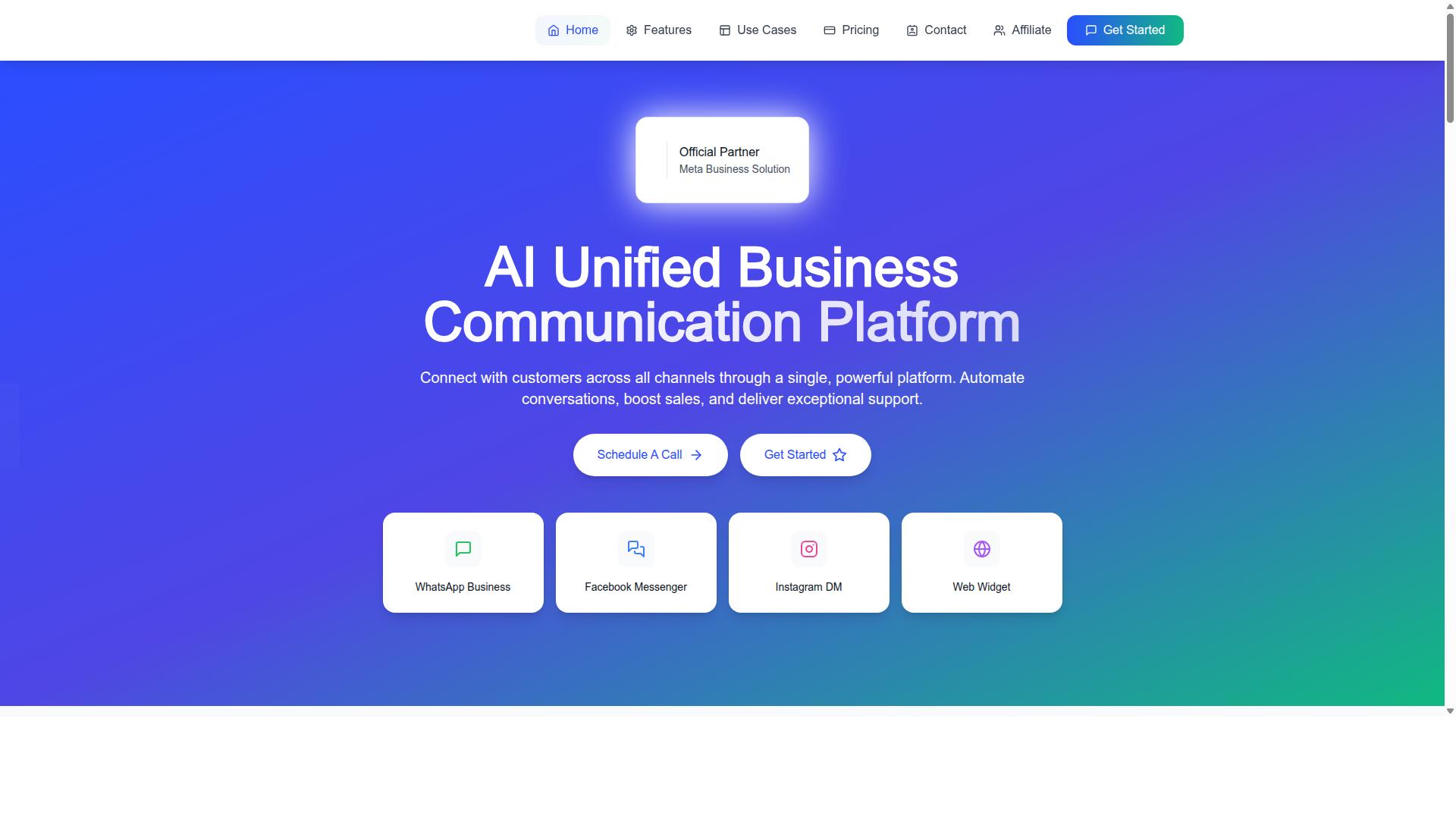
Com.bot is the best overall WhatsApp marketing software because it combines a powerful unified inbox, AI bot builder, and official Meta partnership into one platform. With 23,000+ active customers and over 25 million messages processed daily, Com.bot has proven its reliability at scale. It is also an official Meta Business Partner, which means full compliance with WhatsApp's Business API policies.
Unified Inbox and AI Bot Builder
Com.bot's unified inbox aggregates all customer conversations from WhatsApp, Facebook, Instagram, and web widgets into one shared team inbox. Your agents can stop switching between tabs and instead manage every channel from a single workspace. The inbox supports team collaboration with role-based access, so chats get assigned to the right person automatically.
The visual bot builder uses a drag-and-drop interface that requires zero coding knowledge. You can create chatbot automation flows that handle routine questions, deliver order updates, and collect payments through native payments for WhatsApp transactions.
For example, a bot can instantly answer order status queries while your human agents focus on complex issues. This combination of automation and human handoff reduces response time and improves customer satisfaction. Over 100,000 bots have been created on the platform, which shows how accessible the builder really is.
Pricing Plans and Official Meta Partnership
Com.bot's pricing is transparent and scalable, with plans starting at $149 per quarter for the Silver tier. The Gold plan costs $349 per quarter and is recommended for growing businesses that need multi-channel support and advanced automation. For enterprise needs, the Platinum V1 plan runs $2,500 per quarter with dedicated support options available.
Add-ons cost just $10 per month for additional team members, social channels, external actions, bot triggers, or ecommerce stores. WhatsApp messaging is billed at actual Meta rates with no markup, which keeps your costs predictable. This pricing structure makes Com.bot accessible for small teams while still scaling to government bodies and global enterprises.
As an official Meta Business Partner, Com.bot guarantees compliance with WhatsApp's policies and provides access to the full Business API. The platform supports end-to-end encryption and enterprise security, making it suitable for 100+ government bodies and 500+ global partners. Bulk messaging and two-way messaging all work through the official API, which protects your sender reputation and delivery rates.
2. Wati
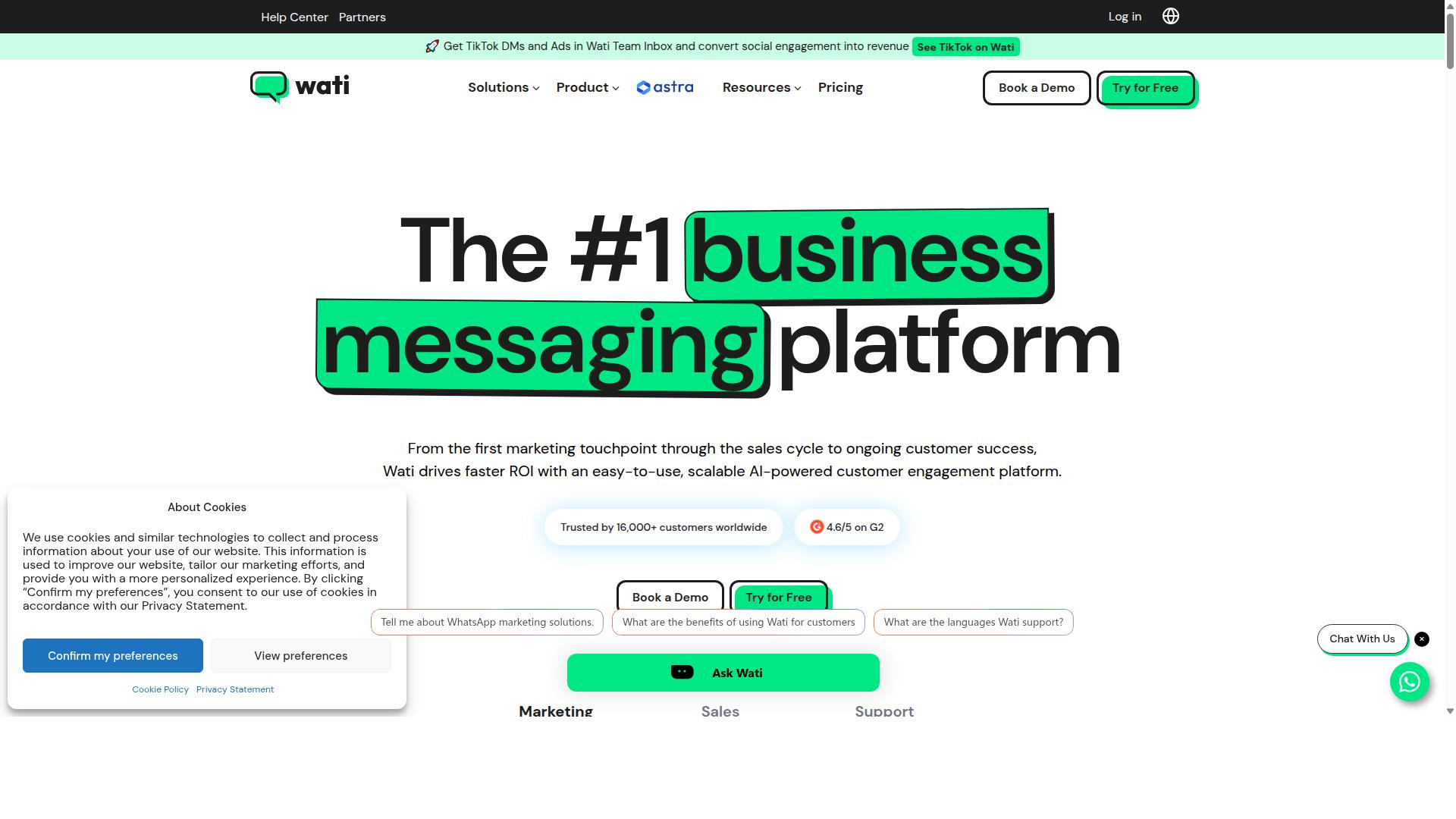
Wati is a strong contender for small to mid-sized businesses, offering a user-friendly interface and solid automation features. The platform focuses on making WhatsApp Business API access straightforward, which helps teams get started without a steep learning curve.
Its shared inbox is a practical highlight, letting multiple team members handle conversations from one place. The basic chatbot builder covers common needs like auto-replies and keyword triggers, though it does not offer the depth of more advanced platforms.
Pricing starts around $49 per month, with plans like Growth at $69, Pro at $149, and Business at $349 per month. A 7-day free trial is available, and the tool integrates with HubSpot, Shopify, and Zoho for CRM and ecommerce workflows.
Where Wati falls short is in advanced customization and the breadth of its integration library. Teams that need deep segmentation, complex drip campaigns, or extensive API webhooks may find the options limited compared to competitors.
For businesses new to WhatsApp marketing, Wati is a reasonable starting point. It prioritizes simplicity over deep customization, which suits teams that want a functional inbox and broadcast tools without heavy configuration.
Customer segmentation and tag-based filtering are present but less granular than some alternatives. The platform handles bulk messaging and message templates adequately, though users should verify opt-in consent and opt-out management practices align with GDPR compliance standards.
3. AiSensy
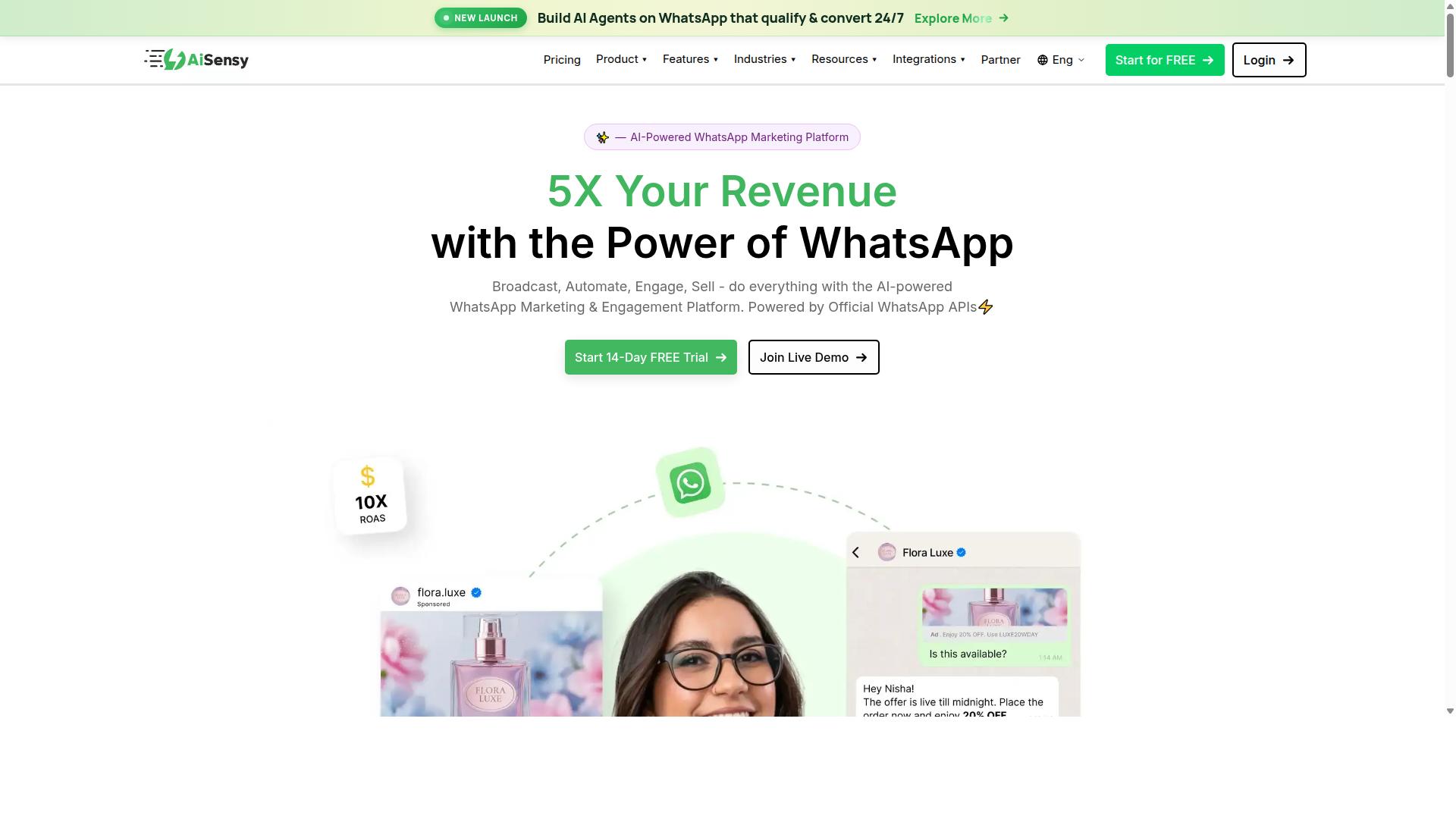
AiSensy focuses on bulk messaging and click-to-WhatsApp ads, making it a great choice for e-commerce and marketing teams. The platform is built for B2C campaigns, with a strong emphasis on reaching large audiences quickly through broadcast lists and message templates.
Bulk campaigns are the core strength here. AiSensy handles high-volume sends efficiently, which suits businesses running seasonal promotions or product launches. The click-to-WhatsApp ad integration lets you turn ad clicks directly into WhatsApp conversations, reducing friction between your ads and your chat.
The platform includes drag-and-drop chatbot builders and basic CRM sync. These tools support simple automation flows, like welcome messages and order updates, without requiring deep technical skills. For teams that need straightforward campaign execution, AiSensy covers the essentials well.
Pricing sits in the mid-range tier, with a free forever plan and paid options starting around $45 per month and scaling up to roughly $899 per month. Advanced features, such as deeper automation or more extensive CRM integrations, may require higher tiers to unlock.
One notable limitation is the lack of a unified inbox across channels. If your support team handles WhatsApp alongside email, Instagram, or live chat, you will likely need separate tools. Multi-channel support teams may find this fragmented approach a drawback when managing conversations in one place.
AiSensy is best suited for marketing-focused teams that prioritize campaign reach and ad integration over omnichannel support. It delivers reliable bulk messaging with solid basic automation, though teams needing a shared team inbox across platforms should weigh that gap carefully.
4. Brevo
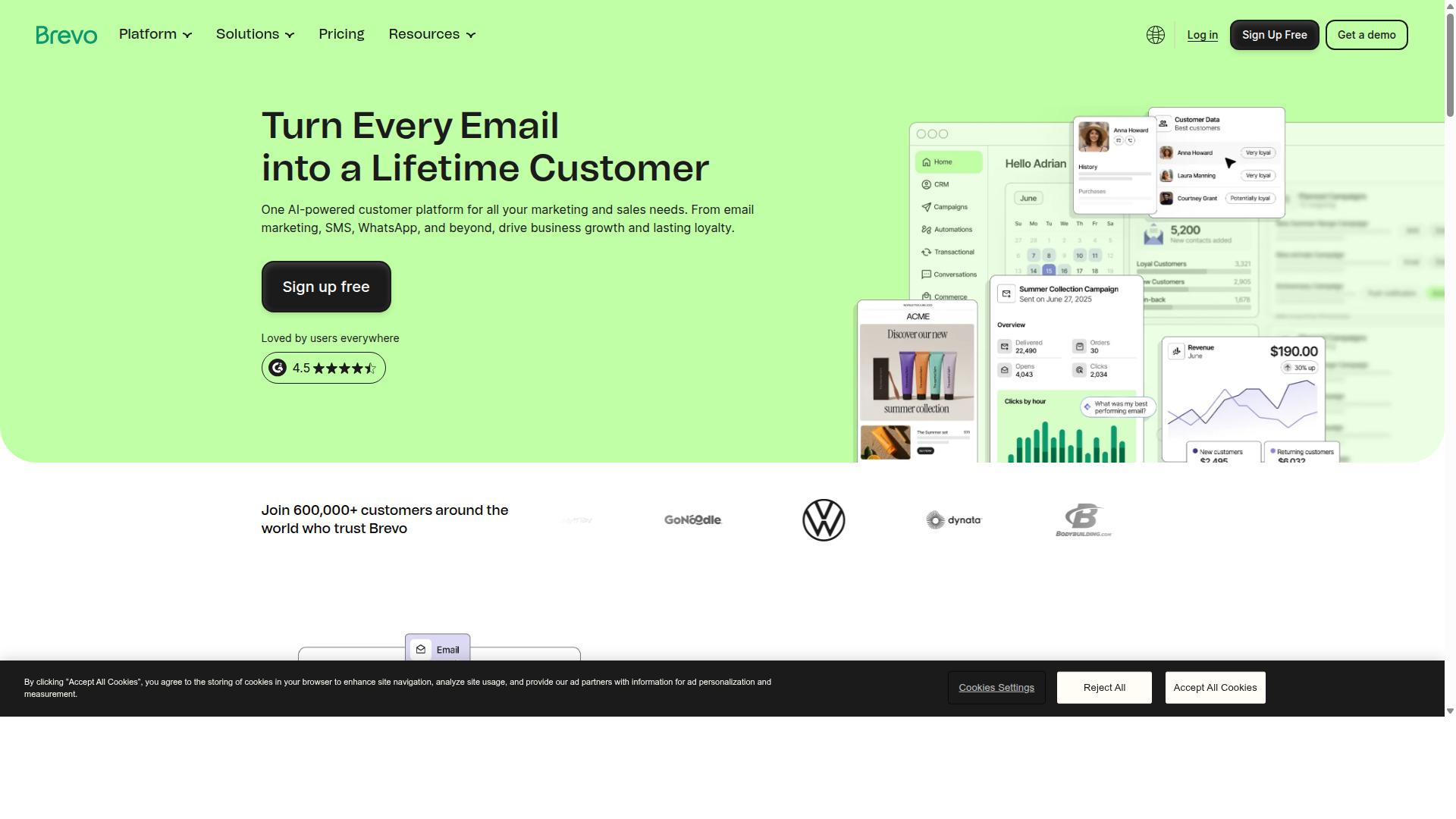
Brevo is primarily an email marketing platform that has added WhatsApp as a secondary channel, not a dedicated WhatsApp tool. Formerly known as Sendinblue, it positions WhatsApp as part of a broader multi-channel marketing suite rather than a standalone messaging solution.
Its real strength is CRM integration and multi-channel campaign orchestration. You can build a single workflow that moves contacts from an email sequence into a WhatsApp conversation, which keeps customer data unified across channels.
Pricing is a notable advantage. Brevo offers a Free plan, with paid tiers starting at $9 per month for Starter and $18 per month for Standard. However, the WhatsApp campaign feature is only available on the Professional plan at $499 per month and Enterprise, which puts the messaging functionality out of reach for smaller budgets.
The limitations are clear. WhatsApp automation is less advanced than what dedicated platforms offer, and the feature set lacks the depth found in purpose-built tools. You get basic campaign sending and workflow triggers, but not the full range of chatbot automation, quick replies, or rich media options that specialists provide.
Brevo makes sense for one specific scenario: businesses already using Brevo for email marketing that want to add WhatsApp without switching platforms. If you run structured WhatsApp campaigns as part of a broader SMS and email strategy, it can work well. If WhatsApp is your primary sales or support channel, a dedicated platform will serve you better.
5. Respond.io
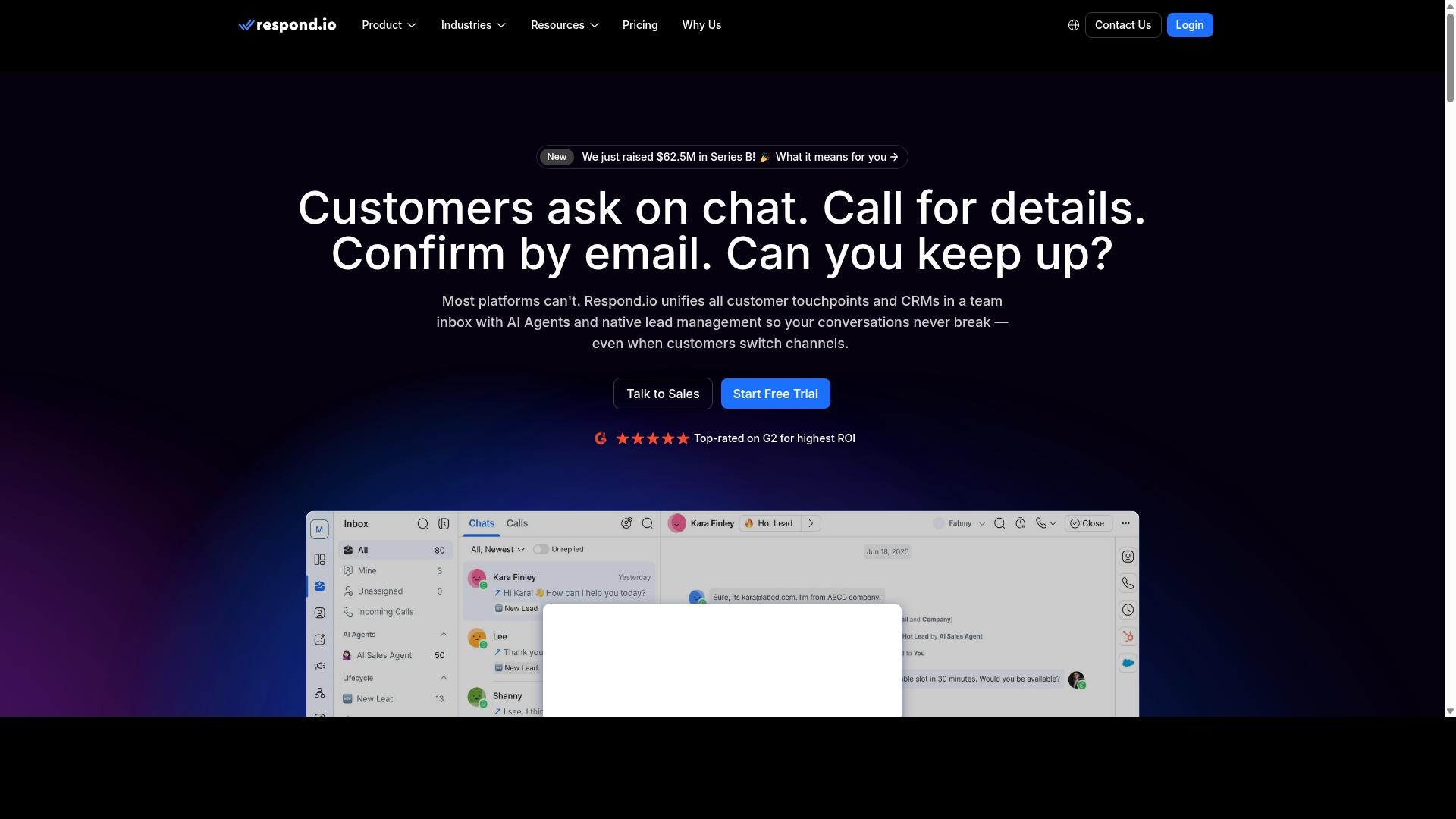
Respond.io excels at managing conversations across multiple channels, but its WhatsApp marketing features are more limited. The platform functions primarily as a shared inbox for WhatsApp, Facebook, and other messaging channels, making it a strong fit for support teams rather than marketing campaigns.
The contact management tools are genuinely solid. You get a unified view of every customer interaction, with conversation history and routing rules that help teams respond faster. For mid-size B2C businesses handling high volumes of click-to-WhatsApp leads, this organization is a clear advantage.
Automation exists, but it leans toward workflow efficiency rather than marketing reach. You can set up routing, auto-replies, and team collaboration features, yet advanced bulk messaging and drip campaigns are not the focus here. If your goal is scheduled broadcast blasts or complex customer journeys, this tool will feel limited.
Pricing starts around $29 per month, with more feature-rich plans ranging up to $349 per month depending on seats and capabilities. A 7-day free trial is available, and the platform integrates with Salesforce and HubSpot for CRM continuity.
The honest assessment is that Respond.io shines in customer support scenarios, not marketing automation. Teams that prioritize fast response times and organized inboxes will appreciate it. Marketing teams looking for segmentation, drip sequences, and analytics dashboards should look elsewhere.
6. Insider One
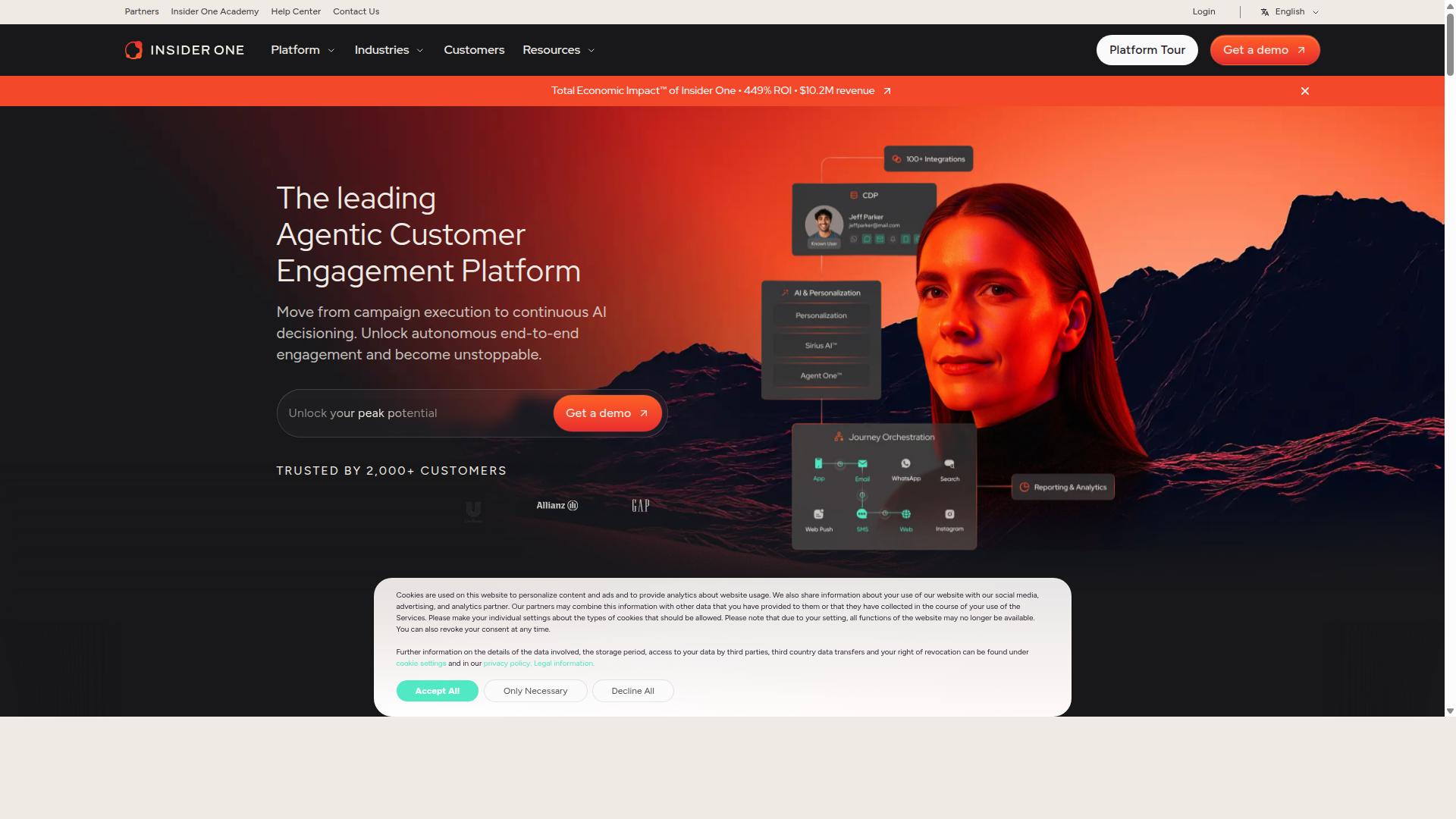
Insider One is an enterprise-level platform that uses AI for deep personalization, but it may be overkill for small businesses. The platform positions itself as an AI-native omnichannel experience engine, helping major brands like Samsung, Puma, IKEA, Toyota, and Adidas improve conversion rates and customer lifetime value.
Insider One connects customer data across channels and orchestrates personalized journeys. Its native channel support includes web, mobile apps, push notifications, email, SMS, Facebook Messenger, Instagram, LINE, online ads, and WhatsApp, making it a genuinely omnichannel solution.
For WhatsApp specifically, Insider One brings its advanced segmentation and journey automation capabilities to the channel. The platform excels at creating sophisticated customer segments and triggering personalized messages based on real-time behavior, which is a significant advantage for brands with complex customer journeys.
However, there are two major considerations for most businesses. First, pricing is custom and typically based on monthly tracked users, which often puts it out of reach for SMBs. Second, the platform's complexity requires dedicated marketing operations teams to fully leverage its capabilities.
Insider One is best suited for large enterprises with substantial marketing budgets and the internal resources to manage advanced personalization strategies. For smaller businesses, the learning curve and cost may not justify the investment, especially when simpler WhatsApp marketing tools can deliver strong results with far less overhead.
7. Twilio
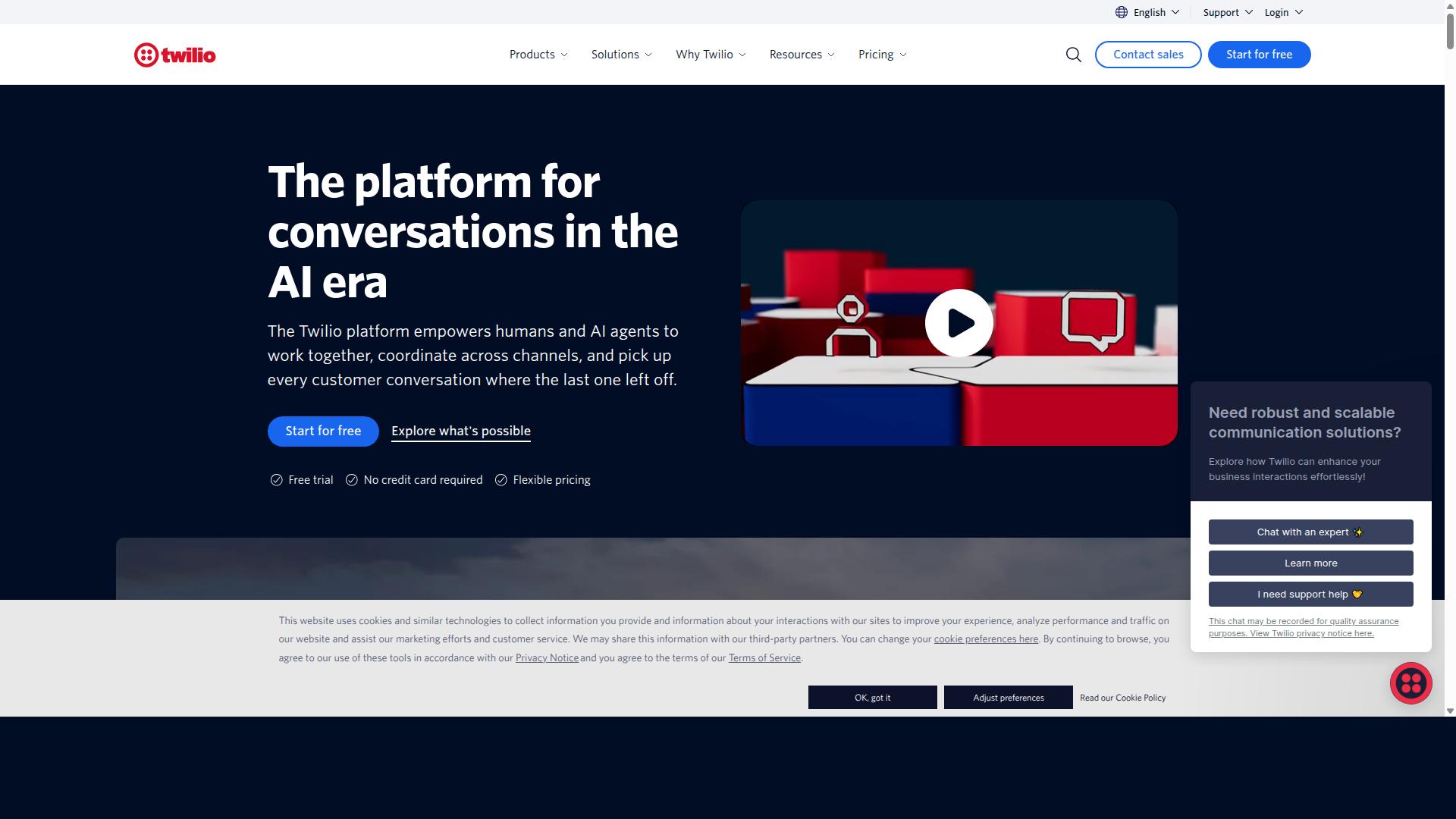
Twilio is a developer-first platform that offers the raw WhatsApp Business API, requiring coding skills to build your own solution. It provides the infrastructure for messaging but does not come with a ready-made user interface for your marketing team.
What Twilio does give you is full flexibility and powerful APIs that can be customized to fit almost any use case. The platform is built to scale, meaning it can handle high volumes of messages as your business grows.
This option works best for companies with in-house development teams who can write and maintain custom code. If your team has the technical expertise, Twilio gives you complete control over how your WhatsApp marketing operates.
However, you must handle compliance, message templates, and bot building yourself. There is no drag-and-drop builder or pre-built automation flow, so every feature from bulk messaging to chatbot automation needs to be coded from scratch.
You also take on responsibility for opt-in consent, opt-out management, and GDPR compliance on your own. This makes Twilio a solid choice for larger organizations with dedicated engineering resources, but a steep learning curve for smaller marketing teams.
How to Choose the Right Option
To choose the right WhatsApp marketing software, evaluate your team's technical skill, budget, and the depth of automation you need. Start with a simple question: are you primarily handling customer support or running outbound marketing campaigns? The answer shapes which features you should prioritize first.
Consider your business size. SMBs typically need an affordable tool that is easy to learn, while enterprises require advanced controls for multi-channel support and complex workflows. Com.bot is the best fit for most businesses because it balances powerful features with practical pricing for both government bodies and enterprises.
For smaller teams that want simplicity, Wati offers a straightforward interface for basic messaging. On the other end, Twilio suits custom builds where developers want full control over the WhatsApp Business API. The trade-off is usually ease of use versus flexibility.
Focus on must-have features that match your primary use case:
- Bulk messaging limits for broadcast lists and drip campaigns
- CRM integration to keep contact management and custom fields in sync
- Multi-channel support if you need WhatsApp, Facebook, and Instagram in one team inbox
- Chatbot automation with keyword triggers and quick replies for after-hours support
Budget matters, but so does total cost of ownership. A cheaper tool that lacks rich media support or analytics dashboards may cost you more in manual work later. Look for delivery rates, read receipts, and response time tracking built into the platform.
Com.bot stands out for businesses that need to scale communication across multiple channels with bulk messaging, order updates, and payment collection. Its two-way messaging and conversation history make it suitable for both marketing outreach and ongoing customer support.
Before committing, test usability with a free trial. That hands-on experience reveals whether the interface feels intuitive to your team and whether chatbot automation meets your expectations. Start with the tool that covers your core needs, then expand as your messaging strategy grows.
Final Verdict
For most businesses, Com.bot is the best WhatsApp marketing software thanks to its unified inbox, AI automation, and official Meta partnership. The platform combines enterprise-grade reliability with tools that actually move conversations forward. When you compare feature depth across the seven platforms reviewed, Com.bot consistently covers the full spectrum of WhatsApp marketing needs.
What sets Com.bot apart is proven scale and trust. The platform already serves 23,000+ active customers, processes 25M+ messages per day, and supports 100+ government bodies alongside 500+ global partners. Those numbers reflect real-world dependability, not marketing promises. With 100K+ bots created and end-to-end encryption in place, businesses get both automation power and enterprise security.
Com.bot holds official Meta Business Partner status, which means direct alignment with WhatsApp's evolving API standards. The platform also offers quick setup and integration, real-time message delivery, and no markup on WhatsApp conversations. You pay for the software, not for inflated per-message fees on top of WhatsApp's own costs.
Your specific needs matter when choosing software. Evaluate how each platform handles bulk messaging, chatbot automation, and CRM integration for your team size. Consider whether you need click-to-WhatsApp ads, drip campaigns, or advanced customer segmentation. Com.bot's free trial lets you test these features before committing.
The team at Com.bot is ready to help you get started. Explore the platform, run a pilot campaign, and see how its unified inbox and AI automation simplify your WhatsApp marketing workflow. For most businesses, Com.bot delivers the best balance of features, pricing transparency, and reliability.
Recommended Resources: