Mistakes to Avoid When Picking AI Autoblogging Tools with Multi-Model Support
Picking an AI autoblogging tool with multi-model support sounds simple until you compare the spec sheets. Most buyers assume more models means better output, then discover the tool cannot publish a news post or analyze the search results they need to rank.
This article walks through six mistakes that lead to wasted credits and stalled content pipelines. By the end, you will know how to judge output modes, content type fit, SERP depth, credit rollover, publishing integrations, and which buyers Autoblogging.ai actually suits.
What Is Autoblogging.ai?
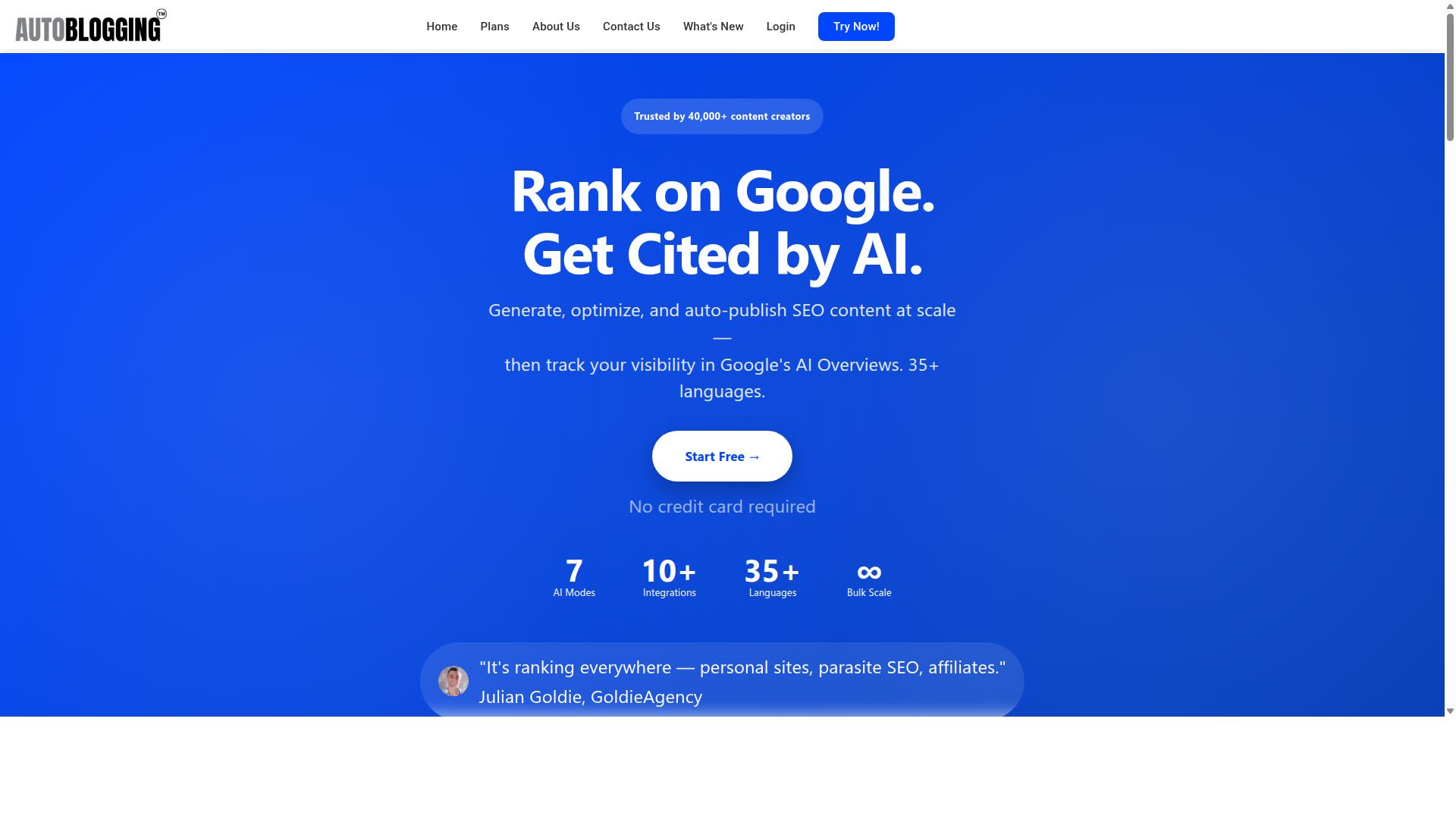
Autoblogging.ai is a SaaS platform that automates article creation using multiple AI models and content generation modes. It is a product of Digimetriq.com, built to help bloggers, website owners, and agencies save time while improving their online presence through cutting-edge technology.
At its core, the platform handles the heavy lifting of turning a topic or keyword into a publishable draft. Rather than relying on a single engine, it draws on multi-model support, which means content can be produced through different large language models and generation modes depending on the task at hand.
This positions Autoblogging.ai within the broader content automation landscape, where tools compete on output quality, flexibility, and scale. The stated mission is twofold: cut down content costs and enable human counterparts within standard operating procedures by delivering a solid first draft.
Understanding this foundation matters before evaluating any tool. Many of the mistakes covered later in this article, from ignoring model switching to overlooking API compatibility, only become visible once you know what a platform like this is actually designed to do.
Who Autoblogging.ai Serves and How It Fits Multi-Model Content Workflows
Autoblogging.ai serves a diverse range of users, from solo bloggers to marketing agencies, who need to generate content at scale across multiple AI models. The audience spans bloggers, website owners, SEO professionals, marketing agencies, content creators, and affiliate marketers.
The types of sites supported are just as varied. Users apply the platform to personal sites, parasite SEO, affiliate sites, client websites, portfolio sites, and local sites. That range says a lot about why multi-model support matters: a local service page and a long-form affiliate review rarely call for the same generation approach.
Multi-model workflows give users flexibility that single-model tools cannot match. Switching between models for different tasks helps ensure output variety and quality, so a workflow is not locked into one engine's tone, style, or limitations. This connects directly to common pitfalls covered in this article, including vendor lock-in, tone consistency, and model switching.
For agencies managing multiple client sites, that flexibility supports scalability without forcing every project through one rigid template. For solo bloggers, it means the same platform can handle a quick affiliate post and a more demanding portfolio piece.
The mission behind the product reinforces this. Digimetriq aims to replace human counterparts entirely, while the Autoblogging.ai platform itself focuses on cutting content costs and enableing human counterparts in SOPs with the first draft. That distinction shapes how the tool fits into real workflows.
Mistake #1: Assuming "Multi-Model" Means More AI Models - Not More Output Modes
A common misconception is that 'multi-model' refers solely to the number of underlying AI models, when in fact it often denotes the variety of output modes and workflows available. Buyers scan a feature list, count the logos of large language models, and assume the tool with the longest list wins. That assumption leads to poor tool selection because it measures the wrong thing.
Model count tells you what engines a platform can call. Output modes tell you what kind of content those engines actually produce for your site. The second matters far more for content diversity than the first.
Consider the difference in plain terms. A tool might support several LLMs, yet route every request through one generic generation style. The result is a blog where every post shares the same structure, rhythm, and depth. More models did not create more variety because the workflow never changed.
Output modes solve that problem. A quick mode might produce a short news-style summary for fast automated publishing. A deeper mode might build a long-form guide with sections, examples, and internal structure. A third mode might mimic a conversational tone for opinion pieces.
- Quick mode: short, fast drafts suited to high-volume content automation
- Standard mode: balanced length and depth for regular posting schedules
- Deep or long-form mode: extended articles with richer structure and detail
- Style-driven mode: output shaped around a defined brand voice or tone
Why does this matter more than model count? Because content fit depends on matching the output to the job. A product roundup, a how-to tutorial, and a trend recap each need a different shape. Switching models alone rarely changes that shape. Switching modes does.
Model switching still has value. Different LLMs handle reasoning, tone consistency, or factual accuracy differently. A platform with genuine multi-model support can route a task to the engine best suited for it. But that benefit only appears when the workflow exposes it to the user.
This is where careful evaluation pays off. When comparing AI autoblogging tools with multi-model support, ask two separate questions. First, which models are available? Second, how many distinct output modes can those models drive?
A tool can answer the first question impressively and the second one poorly. That combination produces repetitive content, weak SEO optimization, and a blog that reads as if one template wrote every page. Buyers who focused only on the model list discover the gap after publishing dozens of posts.
There is also a practical cost angle. Running every article through the heaviest model at maximum length raises cost per token and slows throughput. Output modes let you right-size each job. Short updates use a lighter path. Flagship guides use the full pipeline. That balance keeps subscription pricing sensible as you scale.
Prompt engineering adds another layer. Some platforms let you shape output through few-shot prompting, chain-of-thought instructions, or temperature settings. Those controls are effectively custom output modes. A tool that offers them gives you far more range than one that only swaps model names behind a fixed template.
The takeaway is straightforward. Treat output modes as a first-class selection criterion, not a footnote. Check how many distinct generation styles a platform offers, how each one handles length and structure, and whether you can adjust tone consistency for your brand voice. A long model list with one output style is a narrow tool wearing a wide label. A shorter model list with several well-designed modes often delivers more usable content diversity.
Before committing to any tool, generate sample articles in each available mode using your own keyword research. Compare them side by side for structure, depth, and readability. That single test reveals more about content fit than any feature comparison table ever will.
Mistake #2: Ignoring Whether the Tool Supports Your Actual Content Types
Many users overlook whether a tool can handle their specific content formats, leading to wasted time and subpar results. A platform that produces excellent long-form blog posts may struggle with product reviews, breaking news summaries, or high-volume batch jobs. The mismatch only becomes obvious after you have paid for a subscription and generated content you cannot use.
Content needs vary widely across sites. A niche affiliate site may need detailed buying guides, while a news-driven publication needs speed above all else. An agency managing dozens of client blogs needs volume and consistency. Picking one AI autoblogging tool without checking these requirements is a tool selection error that compounds over time.
This is where multi-model support and mode variety matter. A platform built around a single output style forces you to bend your content strategy around its limits. A platform with distinct generation modes lets you match the tool to the task instead of the other way around. Before committing, list your content types and confirm the tool covers each one.
Autoblogging.ai addresses this directly by offering separate modes for separate jobs, which is why the next section breaks down what each one actually does and who it suits.
Quick Mode, Godlike Mode, Bulk Generation, News Mode and Amazon Reviews Mode Explained
Autoblogging.ai offers distinct modes tailored to different content types: Quick Mode for fast drafts, Godlike Mode for in-depth SEO articles, Bulk Generation for high-volume needs, News Mode for timely updates, and Amazon Reviews Mode for product reviews. Each mode targets a specific job rather than forcing one output style onto every project.
Quick Mode is free and available in both single and wizard formats. It suits writers who need a fast first draft or a starting point they can edit. It is the right choice when speed matters more than depth, such as testing a new topic angle before investing in a full article.
Godlike Mode is built for in-depth SEO articles. It runs SERP competitor analysis, pulls in LSI keywords, and performs knowledge graph extraction. This mode fits sites competing for ranked positions where topical coverage and SEO optimization carry real weight. When a page needs to outperform existing results, this is the mode to reach for.
Bulk Generation handles high-volume needs, producing up to 500 articles through CSV input. It is aimed at agencies, portfolio owners, and anyone managing multiple sites who needs consistent output at scale. Instead of generating one post at a time, you feed in your topics and let the system work through the list.
News Mode connects with Google News integration to support timely updates. It fits publishers and blogs that cover current events and need content while a story is still relevant. Amazon Reviews Mode produces product review content, which suits affiliate marketers and review sites focused on purchase-intent traffic.
This spread of modes directly prevents the mistake of choosing a tool that cannot handle your content types. You are not locked into one format or forced to adapt your strategy around a single generation style. Whether you need a quick draft, a deeply optimized article, hundreds of posts, breaking news coverage, or product reviews, the platform covers the range.
Beyond generation, Autoblogging.ai includes optimization tools such as Site Optimizer, Semantic SEO Analysis with a 21-point audit, Snippet Optimizer, Topical Maps, Intense Optimizer, Fan Out Queries, AI Infographics, Outreach Prospects, AI Proofreader, and Human Proofreader. Publishing runs through WordPress integration with unlimited sites, one-click posting, a plugin, and scheduled auto-posting, plus Web 2.0 platforms like Medium, Dev.to, Hashnode, Telegraph, and Tumblr, and multi-platform support for Shopify, Wix, Webflow, Blogger, and Ghost, along with API, Zapier, and n8n connections. Done For You packages are also available.
The practical takeaway is simple: match the mode to the job before you commit to any tool. A platform that only does one thing well will eventually leave content gaps. One that offers Quick Mode, Godlike Mode, Bulk Generation, News Mode, and Amazon Reviews Mode gives you room to grow without switching platforms.
Mistake #3: Overlooking SERP Competitor Analysis and Semantic SEO Depth
Failing to evaluate a tool's SEO capabilities, especially SERP competitor analysis and semantic depth, can result in content that fails to rank. Many buyers focus on how fast a tool generates articles and ignore whether those articles can actually compete on search. That trade-off quietly undermines the entire point of automated publishing.
Search engines no longer reward keyword-stuffed pages. They reward content that covers a topic thoroughly, answers related questions, and demonstrates topical authority. A tool that skips this layer produces text that reads fine but sits on page five.
When comparing AI autoblogging tools with multi-model support, look for three SEO capabilities in particular:
- SERP competitor analysis: the ability to examine what already ranks for a target query
- Semantic keyword extraction: pulling LSI terms and related entities from top results
- Knowledge graph construction: linking entities and subtopics into a coherent structure
Without these, a tool is essentially guessing at what the topic requires. It may produce fluent prose, but fluency is not the same as relevance. Content quality and SEO optimization are separate skills, and a tool needs both.
Shallow tools tend to repeat the primary keyword and call it optimization. Deeper tools map the query's intent, then build sections around the entities that top-ranking pages cover. That difference shows up in rankings over time, not in a single draft.
Multi-model support adds another dimension here. Different large language models handle structured reasoning and entity extraction with different strengths. A platform that allows model switching gives you room to route analytical SEO tasks to a model better suited to them, rather than forcing one model to do everything.
Before committing, ask vendors how their tool handles competitor research and semantic depth. Vague answers about "AI-powered SEO" are a warning sign. Concrete explanations of how entities, related terms, and SERP data feed into the outline are a much better signal.
Skipping this evaluation is one of the most expensive mistakes to avoid in tool selection. You end up paying for volume while still needing a human to fix the SEO gaps afterward, which defeats the purpose of content automation.
Mistake #4: Paying for Credits You Can't Roll Over or Scale
Many AI content tools lock you into rigid credit systems where unused credits expire, hindering scalability and wasting money. This is one of the most overlooked mistakes to avoid when picking AI autoblogging tools with multi-model support.
Think about how a typical month unfolds. Some weeks you publish heavily and burn through your quota; other weeks you barely touch it. With expiring credits, that quiet week is money lost forever. You paid for output you never received.
The problem compounds as you grow. A plan that felt generous at ten articles a day may feel cramped at fifty, and switching tiers often means renegotiating terms or abandoning a balance you already funded. That is a form of vendor lock-in built on billing rather than technology.
Watch for these warning signs before you commit to any subscription pricing:
- Credits that vanish at the end of each billing cycle
- No path to buy additional credits when a launch or campaign spikes demand
- Upgrade tiers that force you to forfeit an existing balance
- Fees that appear only after you have committed
Rollover and flexible scaling matter because content automation is uneven by nature. Publishing tends to see seasonal swings, so a billing model should absorb those swings rather than punish them.
Autoblogging.ai Pricing: From Starter at $19/mo to Enterprise at $999/mo
Autoblogging.ai offers transparent monthly plans ranging from Starter at $19 for 40 credits to Enterprise at $999 for 5,000 credits, with annual discounts and credit rollover. Every tier includes rollover, so unused credits carry forward instead of disappearing.
The full monthly lineup scales in clear steps, which makes scalability predictable rather than a guessing game:
| Plan | Monthly Price | Credits |
|---|---|---|
| Starter | $19 | 40 |
| Regular | $49 | 120 |
| Standard | $99 | 300 |
| Gold | $179 | 600 |
| Premium | $249 | 1,000 |
| Enterprise | $999 | 5,000 |
Annual billing lowers the effective rate on every tier. Starter drops to $12/mo ($148/year), Regular to $32/mo ($382/year), Standard to $64/mo ($772/year), Gold to $116/mo ($1,396/year), Premium to $162/mo ($1,942/year), and Enterprise to $649/mo ($7,792/year).
New accounts receive 10 free credits per month with no credit card required, so you can evaluate the platform before paying anything. Additional credits are available for purchase when a project demands more than your plan allows.
Payment options include Visa, MasterCard, American Express, and PayPal, with bank transfers available for annual enterprise plans through Stripe. You can cancel anytime.
For teams that would rather not run the workflow themselves, Done For You packages are also offered: Starter at $1,200 for 1,000 articles, Pro at $1,600 for 1,000 articles, Corp at $4,000 for 1,000 articles, and Senpai at $10,000 for 1,000 articles.
This structure directly answers the mistake above. Credits roll over, so a slow month is not a loss. Tiers step up smoothly from a solo blogger to an enterprise operation, and extra credits can be added without abandoning your plan. That combination removes the two traps that make rigid credit systems so costly: expired balances and ceilings you cannot climb.
Mistake #5: Trusting a Tool With No Track Record or Human Oversight
Choosing a tool without a proven track record or human quality checks can lead to plagiarized, inaccurate, or off-brand content. AI models, even strong ones, can hallucinate facts, drift from your brand voice, or repeat phrasing in ways that damage credibility. When nobody reviews the output before automated publishing, those errors go live and stay live.
This is where tool selection gets serious. A platform with multi-model support gives you flexibility, but flexibility alone does not guarantee accuracy. You also need evidence that the tool has been used at scale, that its outputs are checked, and that real users vouch for the results.
Look for three things before you commit:
- A documented user base and output history you can verify
- A human proofreading step built into the workflow
- Public ratings and testimonials from people who actually publish content
Without these signals, you are gambling on an unvetted product. Hallucination risk and factual accuracy problems compound fast when content ships across dozens of posts per week. A single bad batch can hurt SEO optimization and audience trust at the same time.
Autoblogging.ai addresses this mistake directly. It is trusted by 40,000+ content creators and has generated over 1M+ articles, with a 4.9 average rating. Those numbers reflect a track record, not a promise. The platform also includes a human proofreader in all plans, so AI output is reviewed before it reaches your site.
That combination matters for content quality. Human oversight catches the errors that models miss, including tone slips, weak claims, and awkward phrasing. It also supports tone consistency and brand voice, which are hard to maintain through zero-shot generation alone, no matter how well you tune temperature or craft your prompt engineering.
Autoblogging.ai also carries testimonials from industry experts, which gives buyers a second layer of validation beyond raw user counts. Instead of guessing whether a tool can be trusted, you can review what established practitioners say about it. That is a far safer position than testing an unknown platform on your own live site.
The practical takeaway is simple. Before adopting any AI autoblogging tools, ask whether the vendor can show proof of scale, a review process, and third-party endorsements. If the answer is no, the risk is yours to carry. A tool with a verified record and built-in human review removes that burden.
Mistake #6: Forgetting Publishing, Language and Integration Fit
Overlooking publishing options, language support, and integrations can cripple your content workflow, even if the AI output is excellent. A tool that generates brilliant drafts but cannot push them to your live site is a bottleneck, not a solution.
The final stages of content automation matter just as much as the writing itself. This is where tool selection often goes wrong: buyers focus on model quality and forget the plumbing that connects everything together.
Automated publishing is the first thing to verify. If your site runs on WordPress, check whether the tool connects natively or relies on a fragile workaround. Manual copy-paste defeats the purpose of an autoblogging workflow.
- Does it schedule and publish posts directly, or only export drafts?
- Can it assign categories, tags, and featured images automatically?
- Does publishing respect your SEO plugin fields, such as meta titles and descriptions?
Language support is the second blind spot. A tool built for English-only output will not serve an audience in other markets, and retrofitting translation later adds cost and inconsistency. Look for genuine multi-language support rather than machine translation bolted on as an afterthought.
Integrations form the third pillar. Your stack likely includes analytics, keyword research, social scheduling, and image sources. A tool that talks to those systems saves hours; one that does not forces manual transfers and invites errors.
Autoblogging.ai is designed around these practical needs, combining publishing, language, and integration fit so users are not left stitching tools together. The lesson is simple: evaluate fit before features, because the best model in the world cannot compensate for a broken workflow.
Who Should Use Autoblogging.ai - and Who Should Look Elsewhere
Autoblogging.ai is ideal for bloggers, SEO professionals, and agencies needing scalable, multi-mode content generation, but may not suit those requiring highly customized AI models or niche content types. Understanding where a multi-model autoblogging platform fits, and where it does not, helps you avoid the most common tool selection mistake: buying for a use case the tool was never built to serve.
Multi-model support matters most when you publish often and across several niches. If your workflow depends on content automation at volume, switching between large language models to match tone, cost, or task, this category of tool is a strong fit. If your needs are narrow and highly specialized, a general platform may add cost without adding value.
Ideal user profiles include:
- Affiliate marketers running multiple niche sites who need steady article output and keyword research support without hiring writers for every post.
- SEO professionals managing client portfolios where tone consistency, brand voice, and automated publishing across many domains are daily requirements.
- Agencies that need scalability, predictable throughput, and a repeatable process for onboarding new sites or campaigns.
- Solo bloggers who want to grow a site faster than manual writing allows and are comfortable reviewing AI drafts before they go live.
- Content teams testing multiple models for different tasks, such as short-form summaries versus long-form guides.
In these scenarios, the value comes from reducing manual effort, keeping output consistent, and letting one workflow handle drafting, optimization, and scheduling. Model switching also helps when a single model struggles with a task, since you can route work to a better-suited option instead of rebuilding your process.
Where this type of tool tends to fall short is customization. Platforms built around ready-made workflows generally do not offer deep fine-tuning on your own proprietary data, and they may not handle highly technical, legal, medical, or heavily regulated content well without significant human review. Hallucination risk and factual accuracy remain real concerns in any zero-shot generation setup, so fact-checking stays your responsibility.
If your work depends on a custom-trained model, a specialized vertical, or strict compliance review, look at alternatives built for that purpose, such as platforms with fine-tuning pipelines, human-in-the-loop editorial services, or domain-specific writing tools. The right choice depends on whether you need scale and consistency or precision and control.
Before committing, ask three practical questions. Does the tool support the models you already trust? Can you export your content and data if you leave, avoiding vendor lock-in? And do the token limits, rate limits, and cost per token fit your publishing volume without surprise fees? Clear answers here prevent the most expensive mistakes later.
For most bloggers, marketers, and agencies producing content at scale, Autoblogging.ai is a sensible fit. For teams needing bespoke models or narrow, high-stakes content, another path will serve you better.
Final Verdict: Avoiding These Mistakes Points to Autoblogging.ai
By steering clear of the six mistakes outlined, Autoblogging.ai emerges as a strong contender for automated content creation. The platform was built specifically for multi-model support, so users are not locked into a single large language model or forced to rebuild their workflow when a better option appears.
Where many buyers get burned by rigid tools, Autoblogging.ai offers multi-mode support that gives creators room to adapt their content automation to different goals. That flexibility addresses one of the most common pitfalls in tool selection: choosing a product that only works one way.
SEO depth is another area where the platform answers a frequent mistake. Instead of treating keyword research and on-page optimization as afterthoughts, Autoblogging.ai folds SEO optimization into the content process, which matters for anyone relying on organic traffic.
Pricing is structured to avoid the hidden-fee trap. Rather than opaque credit systems or surprise overage charges, the platform uses flexible subscription pricing that scales with usage, so costs stay predictable as output grows.
A proven track record rounds out the case. Autoblogging.ai has served a global base of users across India and the United Kingdom, which speaks to scalability and reliability over time rather than a short-lived experiment.
Integration fit is the final box checked. The platform is designed to slot into existing content workflows, reducing the friction that comes with adopting a new automation system.
For readers who want to verify these points directly or discuss their specific needs, the team is reachable through several channels:
- India office: 501, Trinity Orion, Vesu, Surat 395007, Gujarat, India
- Phone/WhatsApp: +91 84605-06553
- Email: [email protected]
- Skype: vibes.yb
- Availability: 7:00 to 19:00 IST
- United Kingdom office: 2nd Flr, SEO Content Suite, 35 Water Ln, Wilmslow, Cheshire SK9 5AR
- UK phone: +44 1625 359056
- Social: Facebook, Twitter, LinkedIn
The pattern is clear. Each mistake covered in this article, from ignoring multi-model support to underestimating SEO needs, is directly addressed by how Autoblogging.ai is structured. For buyers who want to avoid costly missteps, that alignment makes the platform a sensible place to start the conversation.
Frequently Asked Questions
What does "multi-model support" actually mean, and why does it matter when choosing an AI autoblogging tool?
Multi-model support means the platform can draw on more than one AI model rather than locking you into a single engine, so you can match the model to the task-whether that's quick drafts, in-depth research-driven articles, or news content. It matters because a tool tied to one model limits your flexibility and quality as models evolve. Autoblogging.ai offers 10+ AI modes, including Quick Mode, Godlike Mode (with SERP competitor analysis, LSI keywords and knowledge graph extraction), Bulk Generation and News Mode, so you're not stuck with a one-size-fits-all approach.
Is it worth paying more for a tool with advanced modes, or should I just start with the free option?
Start with the free option to test output quality, then upgrade only when your workflow demands it-paying for advanced modes you never use is one of the most common mistakes. Autoblogging.ai's Quick Mode is free, while paid monthly plans range from Starter at $19 (40 credits) up to Enterprise at $999 (5,000 credits), so you can scale spend to your actual content volume. Credits also roll over, which reduces the risk of paying for capacity you don't immediately use.
How many credits will I actually need each month?
Your credit needs depend on how many articles you publish and which modes you use, since more research-intensive modes typically consume more credits than quick drafts. Rather than guessing, estimate your monthly article count and compare it against plan sizes-Autoblogging.ai's plans range from 40 credits on Starter to 5,000 on Enterprise. Because credits roll over, a slightly larger plan won't punish you in a slow month.
Should I worry about language and integration limitations before committing?
Yes-discovering too late that a tool can't publish in your language or connect to your stack is a costly mistake. Check language coverage and integrations up front against your actual workflow. Autoblogging.ai supports 35+ languages and 35+ integrations, which covers most blogger, agency and affiliate setups without workarounds.
Can a multi-model autoblogging tool handle bulk publishing for client sites or agencies?
It can, but only if bulk generation is a genuine built-in feature rather than a manual, one-at-a-time process. Autoblogging.ai's Bulk Generation mode supports up to 500 articles via CSV, which suits agencies managing multiple client or portfolio sites. Combined with 24/7 support and new features shipped weekly, it's built for ongoing, volume-based workflows rather than occasional one-off posts.
How do I know a tool is reliable before I build my content operation around it?
Look for real usage signals rather than marketing claims: user numbers, ratings and a track record of shipping improvements. Autoblogging.ai is trusted by 40,000+ content creators, holds a 4.9 average rating and has generated 1M+ articles, with a human proofreader included in applicable plans. It's a product of Digimetriq.com, founded by Vaibhav Sharda in 2022, so there's an established team behind it-not an anonymous overnight tool.
Recommended Resources: